
Verse 12: Examine Desire
Introduction
This verse was the first I have encountered in the project with wildly disparate Chinese versions. The lines weren’t in the same order. In some places, the text had three characters represented across the five extant versions. The oldest version didn’t even have a partial copy of this verse. So on and so forth.
Ultimately, a clear and straightforward message emerged: Pay attention to how your lifestyle impacts your state. Orient from interior wisdom, not as a slave to the exterior sense experience.
Along the way, I made subtle decisions with nuanced but profound implications on the philosophical underpinnings. Without further ado, let’s get started!
Translation
The five colors cause people’s eyes to go blind.
The five sounds cause people’s ears to go deaf.
The five flavors cause people’s mouths to spoil.
Racing around on the hunt causes madness in the mind.
Pursuing after treasures causes our behavior to waiver.
Therefore, let go of that and hold this
according to the inner and not the outer.
This is how the Wise govern themselves.
Commentary
The five colors cause people’s eyes to go blind.
The five sounds cause people’s ears to go deaf.
The five flavors cause people’s mouths to spoil.
Like most ancient cultures, the Chinese have a system of five elements. One of the delightful qualities of the Chinese system is that it organizes many aspects according to this elemental perspective. Here is a reference for the idea regarding the colors, sounds, and flavors, though please note that there are other versions.
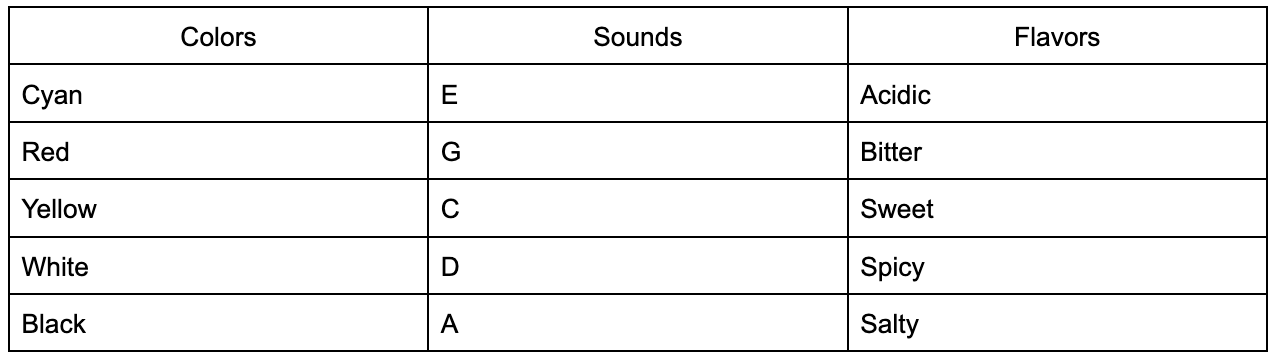
Working with the five elements is a rich process, a portion of which was explored in a series in the fall of 2023. Feel free to check out those articles on substack!
These three lines evoke a universal spiritual truth: getting wrapped up in the sensory experience is a problem. When our attention is absorbed in external sights and constantly stimulated, we lose sight of what’s essential. This can be metaphorical, pointing to prioritizing time in front of the TV over one’s health, or literal, in terms of hyper-stimulation that reduces our ability to be present in the simple beauties of life. The same is true of sound, taste, and, by extension, the rest of our sensory experience.
One of the things that happens when we get caught up in the external world is that we become confused about our identity. We pursue things to satisfy the senses rather than to fulfill our innermost needs. Our innermost needs are a subtle, quiet voice that can be “drowned out” by the chaos of chasing after sensory things. The Dao is subtler yet.
The Weaving Way is not a life-denying path. It’s a non-dual principle of transcendence, meaning the Dao is separate from everything, and immanence, meaning the Dao is perfectly present in everything. While it shares some common elements with other East Asian Wisdom traditions, it’s essential to recognize that its notion of liberation is not a form of escapism. Keeping our consciousness from being overwhelmed by sensory experience is in service to seeing natural law clearly here and now. The meditation instructions in “Verse 10: Can it Be?” invite us into this state of being.
Racing around on the hunt
causes madness in the mind.
Pursuing after treasures
causes our behavior to waiver.
The allusions here invite us to contemplate how our behavior affects our spirit and how that, in turn, shapes how we show up in the world.
In these opening lines, a critical character evolved from the oldest to the newest versions of the text. The oldest versions use 使 (shǐ), while the newer versions use 令 (líng). In many ways, these characters are synonyms for making something happen. The slight distinction is as follows:
- 使 (shǐ) is impersonal and more aligned with general notions of cause and effect.
- 令 (líng) is personal and has more to do with ordering someone to do something or causing a specific subjective experience to arise in someone.
I have elected to use the older version 使 (shǐ) throughout the text because it more closely aligns with the overall philosophy. A singular impersonal force flows through all that is, functioning via the dynamic interplay of opposing forces. Personality and subjectivity are divine figments of imagination arising from the interplay of such natural law.
One of the beautiful side effects of this worldview is that we are wholly conditioned entities. We run programs to navigate our world; those programs are typically unconsciously conditioned instead of consciously chosen. When we pay attention, we can see how they impact our experience, like in the examples above. Seeing the impacts of causation gives us the opportunity, even the obligation, to take responsibility for the programs we run and to recondition them as necessary.
The two lines we are discussing now evoke several common phenomena. In brief:
- Running around like crazy.
- It keeps our minds so busy and preoccupied we can’t take time to prioritize what really matters.
- Exposure to cruelty.
- The more violence, meanness, gossip, cruelty, pettiness, envy, jealousy, and objectification that we are exposed to, the more OK we are with it. We can get numb and passively unconsciously adopt the same attitudes within ourselves.
- Greed.
- How easy is it to bend our ethics to get or avoid something? Few things will break someone the way needing something does
Each topic deserves a manifesto. Instead, I’ll stop here and invite you into further contemplation.
Therefore, let go of that and hold this
according to the inner and not the outer.
This is how the Wise govern themselves.
The structure of the Chinese has this reversed:
It is by these means the wise govern themselves,
Attending to the stomach (interior) and not to the eye (exterior),
Therefore releasing that and holding on to this.
I felt that presenting it literally like that was a bit awkward, and switching to a more native style didn’t corrupt the simple but profound lesson it presented.
Follow your inner wisdom when deciding what to do, take in, spend time on, etc. Do not mindlessly follow your sensory experiences into temporary pleasures and the resultant, unavoidable dissatisfaction.
Gaze upon that which is truly beautiful. Listen to that which is wholesome. Eat that which is healthy. Regulate your activity according to your innermost purpose. Pay attention to the habits normalized by social conditioning; choose your friends, occupation, and activities wisely. Improve your life circumstances with gratitude and contentment directed by what is necessary for common well-being, not personal greed or envy.